
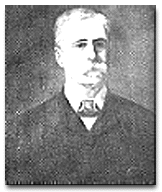
John Doby Kennedy ()
Confederate Brigadier General and
Lieutenant Governor of South Carolina
Brigadier-General John D. Kennedy was born at Camden, January 5, 1840, son of a
native of Scotland, who settled in Kershaw county about 1830, and married a
granddaughter of Abraham Belton, a pioneer of Camden and a soldier of the revolution.
He was a student at the South Carolina college, read law, and was admitted to practice
in January, 1861, but at once gave himself to the military service of his State.
In April, 1861, he became captain of Company E, Second South Carolina infantry,
under Col. J. B. Kershaw. With this command he was in the first battle of Manassas,
and was struck by a Federal ball. Upon the promotion of Kershaw to brigadier-general
he became colonel of the Second regiment, and in that rank participated in the skirmish
on the Nine-mile road near Richmond, in June, 1862, and the battle of Savage Station,
after which he was disabled for some time by fever. During the investment of Harper's
Ferry he was with Kershaw's brigade in the capture of Maryland heights, and at Sharpsburg
his regiment was the first of the brigade to come to the relief of Jackson. He drove
the enemy from his front, but fell painfully wounded in the first charge. At Fredericksburg
he was sent with his own and the Eighth regiment to the support of General Cobb
at Marye's hill, the focus of the hottest fighting of that memorable battle,
and aided materially in the defeat of the Federal attacks; and at Chancellorsville
he was identified with the gallant action of his brigade. During 1864 when not
disabled he was either in command of his regiment or of Kershaw's old brigade,
in the Richmond and Shenandoah Valley campaigns, and in December he was promoted
to the temporary rank of brigadier-general. With his brigade in McLaws' division
of Hardee's corps he took part in the final campaign in North Carolina against Sherman,
including the battle of Bentonville, and surrendered with the army at Greensboro.
He was six times wounded during his service, and was hit fifteen times by spent balls.
After the close of hostilities he was mainly engaged in planting until 1877, when
he resumed the profession of law. He was elected to Congress in 1865, but declined
to take the "ironclad" oath demanded and did not take his seat. In 1878-79 he represented
his county in the legislature, was elected in 1880 and served as lieutenant-governor
of the State to 1882, and in the latter year was a prominent candidate for the
nomination of governor. In 1884 he was presidential elector-at-large on the
Democratic ticket, and in 1886 was appointed consul-general at Shanghai,
China, by President Cleveland. Returning from that post in 1889, he continued
the practice of law at Camden until his death in April, 1896.
He married Elizabeth Cunningham and they had 7 children. After she died, Kennedy married Harriet Boykin
and they had one child. Kennedy died on April 14,
1896.
Bio. Source: On-Line