
Joseph Brevard Kershaw ()
Confederate Major General;
Member of the South Carolina
House and Senate; Judge
Joseph Kershaw was the embodiment of the Confederate gentleman-turned-soldier ideal, a lawyer from the "Cradle of the Rebellion," South Carolina. He was intelligent, literate, and dignified, a man of high character in whose life religion had first place. Blond, with light blue eyes, refined features and a resolute expression, he was clean-shaven except for a drooping blond mustache. He had the bearing of command and a clear voice that seemed to inspire courage when it was raised in battle. "Gallant and pious," was how division commander McLaws described him; "cool and judicious."
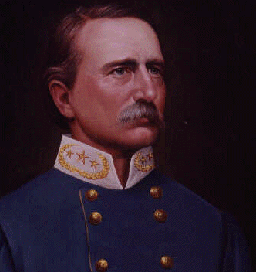 His father was several times mayor of Camden, S.C., and served a term as a member
of Congress. Young Joseph, though orphaned at seven, studied law and was
admitted to the bar in 1843. In addition to his law career Kershaw had some
military experience, having been a lieutenant with South Carolina's "Palmetto Regiment"
in the Mexican War. Later a member of the state legislature and a member
of his state's secession convention, he raised a militia regiment which
went into Confederate service as the 2nd South Carolina regiment when the
Civil War began. When he went off to war, his beautiful wife Lucretia made
herself a necklace and bracelets woven from locks of his hair.
His father was several times mayor of Camden, S.C., and served a term as a member
of Congress. Young Joseph, though orphaned at seven, studied law and was
admitted to the bar in 1843. In addition to his law career Kershaw had some
military experience, having been a lieutenant with South Carolina's "Palmetto Regiment"
in the Mexican War. Later a member of the state legislature and a member
of his state's secession convention, he raised a militia regiment which
went into Confederate service as the 2nd South Carolina regiment when the
Civil War began. When he went off to war, his beautiful wife Lucretia made
herself a necklace and bracelets woven from locks of his hair.Kershaw's regiment was present at Fort Sumter and First Manassas. He had some rough edges early on--he annoyed commanding general Brig. Gen. P.G.T. Beauregard after First Manassas by not filing a report with him and instead writing an article for a South Carolina newspaper in which it appeared that Kershaw had won the battle himself. Beauregard later referred to him as "that militia idiot." Fortunately for Kershaw, Beauregard was transferred away from the Virginia army, and in January 1862 Kershaw took command of his brigade when the previous commander, Brig. Gen. Milledge Bonham, resigned in a huff over a seniority dispute. Two weeks later Kershaw was promoted to brigadier general.
On the Peninsula the next summer, Kershaw led his brigade in action at Williamsburg and again at Savage Station during the Seven Days' Battles. In division commander Maj. Gen. Lafayette McLaws's official report after those battles, he wrote "I beg leave to call attention to the gallantry, cool, yet daring, courage and skill in the management of his gallant command exhibited by Brigadier-General Kershaw." Thus there was already much expected of Kershaw and and his men before the Maryland Campaign in September, where Kershaw's men forced Union soldiers off the critical Maryland Heights before the capture of Harper's Ferry. There, some of the men had to load and fire from positions where they had to use one arm to keep from rolling down the mountainside. After the Battle of Sharpsburg at the climax of that campaign, Kershaw was again highly praised by McLaws.
At Fredericksburg, Kershaw had his finest hour, reinforcing Brig. Gen. Thomas Cobb's brigade behind the Stone Wall on Marye's Heights and taking command of that embattled salient when Cobb was mortally wounded. Leading his brigade on horseback, Kershaw emerged on the crest of the hill a conspicuous and defiant target, seen and admired by thousands on both sides. It was said later that when he reined in his horse, the Yankees withheld their fire as if out of respect, and that Kershaw took off his cap in acknowledgment before he disappeared behind the bastion of the Stone Wall. At Chancellorsville, for once, Kershaw was not heavily engaged.
By the summer of 1863, Kershaw, forty-one years old, had been a brigadier for a year and a half, and had distinguished himself in almost every battle Lee's army had fought. Kershaw showed an ability for quick rational decisions--he had both dash and good sense. His brigade was always well put in, and Kershaw never endangered his men rashly. McLaws had complete faith in him and his brigade, and he was much admired by his South Carolinians. The official reports Kershaw wrote are graceful, literate, and restrained. He was a man who passed among the whistling bullets and shrieking shells with a calm center, never losing his dignity.
Bio Source: Excerpted from "The Generals of Gettysburg: The Leaders of America's Greatest Battle" by Larry Tagg
Picture credit: Joseph A. Matheson, Confederate Historian and Editor