
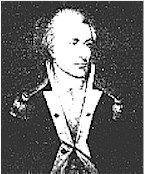
Thomas Sumter ()
Revolutionary War Brigadier General;
Member of the South Carolina House and Senate;
Congressman and U.S. Senator
General Thomas Sumter was born in Virginia, August 14, 1734 the son of William and
Patience Sumter. Educated in common schools he engaged in surveying in Virginia,
worked in his father's mill and after his father's early death cared for his mother's
sheep and plowed his neighbor's fields.
A sergeant in the Virginia Militia he campaigned against the Cherokees.
He accompanied a delegation to London and acted as interpreter for Cherokee
Indians before King George III. Returning to the colonies October 28, 1762,
he landed in Charleston and spent that winter with the Cherokees. During
that time he single handedly captured Baron Des Onnes, a French emissary sent
to stir up trouble between the British and Cherokees. He was paid by the British
ministry' for information about Indian affairs along the frontier. Returning briefly
to Virginia, he was arrested for an old debt, but escaped from Stanton Prison and
came overland to Eutaw Springs, SC where he invested his savings in land and slaves.
He also opened a crossroads store and earned such respect from the community
that he was made a justice of the peace in 1766.
Four years later he married the wealthy widow, Mrs. Cantey Gemstone,
seven years his senior. They settled in St. Mark's parish, opened another
store, a sawmill and a grist mill. They had one child, a son, Thomas Sumter,
Jr., born August 30, 1768.
GENERAL THOMAS SUMTER'S MILITARY CAREER
Served in Virginia Militia during Cherokee Indian War. Came to SC about 1760.
In Indian service on frontier for several years.
Captain in the "Snow Campaign" to subdue upcountry Tory (Loyalist) forces, 1776.
Lt. Col, 2nd SC Rifle Regiment, 1776.
Battle of Sullivan's Island, June 28, 1776.
Williamson's Campaign against Cherokees, Fall of 1776.
Georgia Campaign against the British (Fraser) raid from St Augustine.
Colonel of The Regiment, Continental Line, 1778.
Resigned commission as Commander of The Regiment, Continental Line, 1778.
After fall of Charleston to Clinton, 1780, while SC lay prostrate, Thomas Sumter
formed the first
militia to renew the struggle. For 18 months he alone was the SC government, Governor
Rutledge having moved the capitol to North Carolina.
Repulsed in attack on Tumbull's camp at Rocky Mount, July 30, 1780.
Defeated British at Hanging Rock, August 6,1780, destroying Prince of Wales Regiment.
Defeated in surprise night attack by Tarleton at Fishing Creek, August 18, 1780.
Commissioned Brigadier General By Gov. Rutledge,October 6, 1780.
Won Battle at Fish Darn Ford, November 9, 1780 and captured Wemyss, British Commander.
Defeated Tarleton at Blackstock's, November 20, 1780. Wounded in back and chest
General Thomas Sumter served his country under four presidents.
General Thomas Sumter's service to his country during the Revolutionary War is well
known and documented. His service to the fledgling Republic is perhaps not so
well known. He was a man of many and varied interests ranging from experiments
with tobacco and cotton and silk worms. He also raised fine racing horses. He
founded the town of Stateburg after the war and held land grants for more
than 150,000 acres of land. Service to his community, state and country
continued from 1782 to December 16, 1810 when he retired from public life.
He was elected a delegate from the district eastward of the Wateree
to the First and Second Provincial Congresses which met in Charles
Town in 1775 and 1776. There he was made a member of Council of Safety and
immediately after the Skirmish at Lexington was made a Captain of Rangers,
and then a Lt. Col. Commandant of rifle regiment He was also present and
took part in the adoption of the second American State Constitution by the
terms of which SC became an independent sovereignty.
In 1778 he was elected by his people to the first General Assembly under
the new Constitution, and after his "War Days was elected to the state
Senate which met in Johnsonborough, SC in 1782. Meanwhile, after having
moved to Stateburg in what was then Camden District, from his former home
on the Santee River, he was elected to the Assembly which me in Charleston
in 1785. He was re-elected and was a member of~the Assembly when, in 1788,
the Proposed Constitutional Convention, was received. He was again
a member of the Legislature which me in 1789, this being his last
session in the State General Assembly, thereafter refusing other nominations.
He was elected to the First Congress which me in NY in 1789. He was elected
to the Second Congress but suffered his only defeat in the election of 1793.
He remained out of politics for three years but in 1796 he again offered
and was elected as a member of Congress held in the new Capitol in Washington DC,
he was the only member from SC who voted for Jefferson instead of Burr when
the election for President was thrown into Congress.
December 1801, the General Assembly of South Carolina elected Congressman
Sumter over John Rutledge to fill Charles Pinkney's unexpired term as
a Senator when the latter was sent to the Court of Spain. At
the expiration of the term he was elected Senator and re-elected in December 1810.
But Sumter then 76 years of age and beginning to be weary of public
service and harassed by complications in his vast private enterprises,
resigned and retired to end his days among the High Hills of Stateburg.
In the last year of life, he took a stand on a principle of government
closest to his heart - that principle then, and now, referred to
as "States Rights." It was then (1832) that Calhoun's doctrine
of The right of anullifications by a state, in the event its reserved
powers had been transgressed upon by the Federal Government, was being
insisted upon by South Carolina. That dispute was at its height when he
died on June 1, 1832 at the age of 98. He was the last surviving
general officer of the American Revolution. He is buried at "South Mount", his home in Stateburg.
Bio. Source:
Archives
Fort Sumter National Monument